Hip bursitis doesn't usually show up as an emergency. It shows up mid-set, right as you drop into a squat or roll onto your side to stretch, and suddenly your outer hip lights up. If you're working out with hip bursitis, the real challenge isn't finding a list of approved exercises. It's knowing, in the …

Hip bursitis doesn’t usually show up as an emergency. It shows up mid-set, right as you drop into a squat or roll onto your side to stretch, and suddenly your outer hip lights up. If you’re working out with hip bursitis, the real challenge isn’t finding a list of approved exercises. It’s knowing, in the moment, whether that twinge means back off or whether it’s safe to keep going.
What’s Actually Happening When Hip Bursitis Flares During Training
The bursa at the outside of your hip is a small, fluid-filled sac that sits between your gluteal tendons and the bony point of your hip, the greater trochanter, which is why the condition is often called trochanteric bursitis. Its job is to reduce friction as those tendons glide with every step. When it gets irritated, usually from repetitive movement, prolonged compression, or a sudden jump in training volume, it swells and becomes sensitive to anything that presses on it or overworks the muscles around it. Common hip bursitis symptoms include tenderness right at the outer hip, pain that worsens with stairs or lying on that side, and a dull ache that can radiate down the outer thigh.
That’s why hip bursitis so often flares during exercise rather than at rest. Movements that compress the outer hip or ask the glutes to work hard under load put direct stress on an already inflamed structure. Once you know which movements do that, you can adjust mid-workout instead of guessing. If your pain sits more on the outer hip generally rather than flaring specifically during training, our guide to outside hip pain breaks down how bursitis compares to other common causes.
Everyday Habits That Feed a Flare
Training isn’t the only thing loading the bursa. Weak hip muscles, especially the glutes, let other structures pick up the slack, which increases stress on the bursa even outside the gym. Poor posture, standing on one leg for long stretches, or crossing your legs while seated all keep the outer hip in a compressed position that adds up over the course of a day.
Sleep position matters too. Lying directly on the affected hip night after night keeps pressure on an already irritated bursa, so a pillow between your knees or sleeping on the other side can take real pressure off during recovery. Underlying conditions like inflammatory arthritis, including rheumatoid arthritis, can also raise your risk of hip bursitis in the first place, which is worth mentioning to a physical therapist if flares keep recurring despite training modifications.
Gym Movements That Commonly Flare Hip Bursitis
Not every lift affects the bursa the same way. When you’re working out with hip bursitis, these five patterns are the ones to watch.
Squats and Deep Hip Flexion
Deep squats push the hip into a range where the IT band and glute tendons compress directly over the bursa. The deeper you go, the more that compression builds, which is why squats are commonly flagged as movements to modify rather than avoid outright.
Lunges and Split-Stance Work
Lunges load one hip at a time, so the working hip absorbs your full bodyweight plus whatever you’re holding. A long, deep lunge stance increases hip flexion and adduction together, a combination that tends to aggravate hip bursitis faster than a shorter, shallower stance would.
Side-Lying and Ground-Based Positions
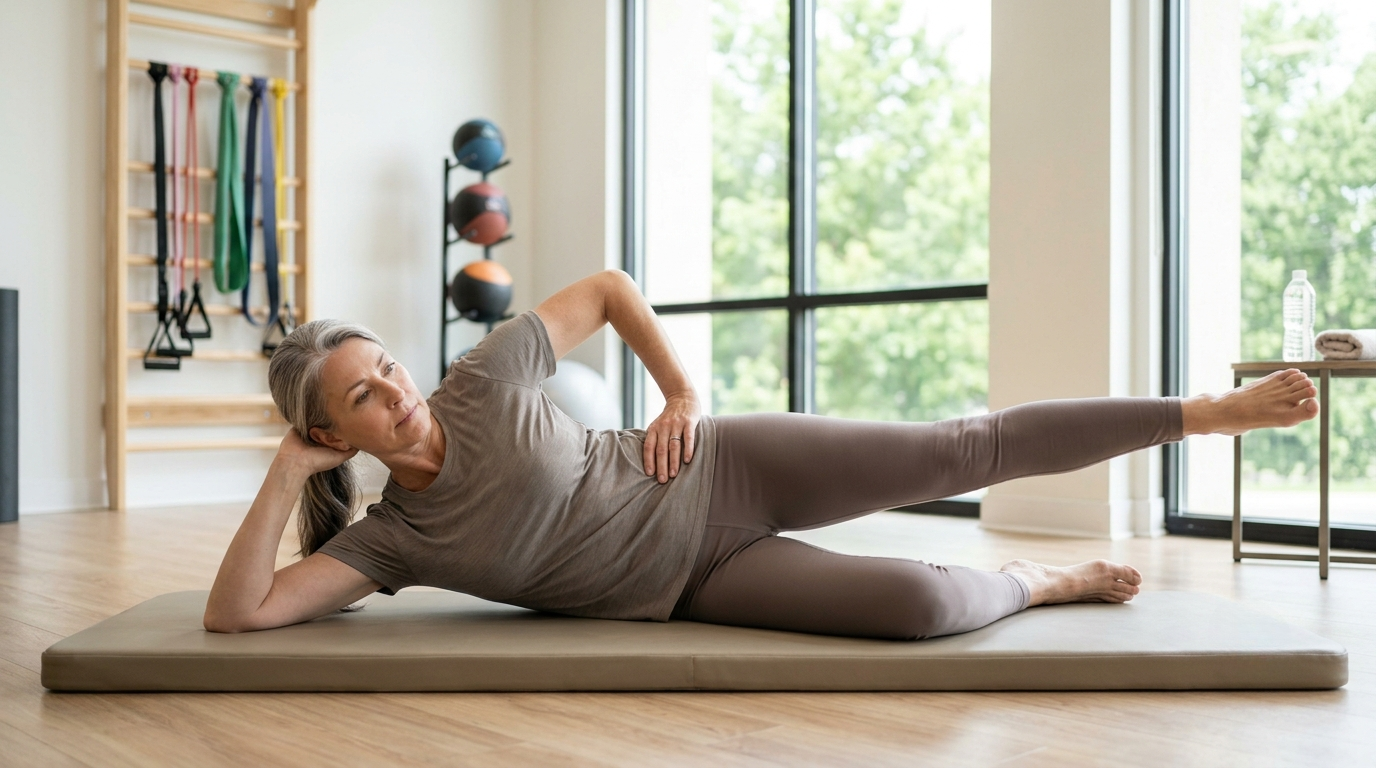
Anything that puts direct pressure on the affected hip, like side-lying stretches, side planks, or lying on that hip between sets, can worsen symptoms through compression alone. This is separate from the exercise itself; it’s about which side of your body bears weight.
Running and Repetitive Impact
High-impact activities like running and jumping load the hip thousands of times over a single session. Each foot strike sends a jolt through the outer hip, and that repetition is exactly what an irritated bursa struggles to tolerate.
Cycling and Prolonged Hip Flexion
Cycling seems low-impact, and in short doses it usually is. But prolonged cycling with high resistance keeps the hip in sustained flexion while the glutes work continuously, which can aggravate the bursa if a session runs long.
How to Modify Load, Range of Motion, or Exercise Selection on the Spot

You don’t need to abandon a workout the moment your hip complains. Most of the time, a small adjustment made in real time is enough to keep training without pushing symptoms further.
Adjusting Load
Dropping the weight is usually the fastest fix. A squat or hip abduction exercise that flares at a heavy load may feel fine at half the resistance, because lighter load means less compressive force through the bursa with each rep.
Adjusting Range of Motion
Shortening how far you move often solves the problem without changing the exercise entirely. A partial squat instead of a deep one, or a shorter lunge step, keeps you in a range where the tendons and bursa aren’t pinched as hard.
Swapping the Exercise
Sometimes the smartest move is trading the exercise for a close substitute. Standing hip abduction can replace a side-lying version if lying on the hip is the problem, since it strengthens the hip abductor muscles and improves hip stability without any direct pressure on the bursa. A glute bridge can often stand in for a squat pattern when deep hip flexion is what’s flaring things up, and it strengthens the glutes and hip stabilizers without compressing the lateral bursa.
If a clamshell is provoking pain in the standard side-lying position, doing it from a seated position instead keeps the same top-knee movement without any weight on the affected hip. And if lying on your back with your legs straight is uncomfortable, change the starting position. Bend the knee and keep your opposite leg stabilizing you. A bent-knee leg lift from there usually keeps the hip abductors working without aggravating the bursa.
Should You Push Through or Back Off Today?
This is the decision that matters most when you’re working out with hip bursitis, and it comes down to what kind of discomfort you’re feeling. A dull, general muscular ache that shows up during effort and fades quickly afterward is usually fine to work through. Sharp, localized pain at the outer hip, or discomfort that lingers after you’ve stopped moving, is your signal to modify or stop.
Pain that worsens the longer you train, rather than staying steady, is another sign the current load is too much for where your hip is today. In that case, scale back the session rather than push to finish it as planned. Training through a flare rarely saves time; it usually adds days onto your recovery.
Stop Signs During a Workout
A few in-the-moment signals are worth treating as a hard stop rather than something to push through:
- Sharp pain that spikes with a specific movement and doesn’t ease when you back off the range or load
- Pain that changes your gait or form to compensate, since that shifts stress onto other joints
- A hip that feels noticeably weaker or less stable than it did at the start of the session
- Pain that’s still elevated an hour or more after you’ve finished training, rather than settling quickly
Most of the time, these just mean today’s session needs to end early or shift toward lower-stress movement. If they keep showing up, get the hip assessed.
How to Ease Back Into Full Training
Once a flare has calmed down, jumping straight back into your previous training volume is one of the most common ways people re-irritate the bursa. A better approach is a gradual reload: start with the modified versions you used during the flare, hold there for a few sessions, and only add back load, depth, or impact once each stage feels consistently pain-free.
Complete rest isn’t the goal either. Staying completely inactive can weaken the muscles that stabilize your hip, which sets you up for another flare once you return to training. Staying active with modified movement while you rebuild tolerance tends to get people back to full training faster than either extreme.
When to See a Physical Therapist
Most cases of hip bursitis respond well to smart training adjustments, but a few situations call for professional evaluation rather than more trial and error:
- Pain that hasn’t improved after a couple of weeks of consistent modification
- Symptoms that are getting worse instead of better despite backing off training
- Difficulty walking, climbing stairs, or sleeping on the affected side
- Weakness in the hip that makes you feel unstable during everyday movement, not just during exercise
A physical therapist can assess your walking pattern, hip strength, and movement mechanics to find what’s actually driving the irritation, which beats continuing to guess at modifications on your own. At Sustain Physical Therapy and Performance in Boston’s Back Bay, every session is 60 minutes, one-on-one with a Doctor of Physical Therapy. We treat hip pain in active adults who don’t want to stop training, and we build your plan around what you can still do, not just what you can’t. Your exercises go into an app with video, so you know what to do between visits. Our team specializes in getting people back to full training loads without unnecessary time off.
You don’t have to stay out of the gym with hip bursitis. You do have to know which movements to modify, how to read your hip’s response mid-set, and when to bring in a professional. Our physical therapy services are built around all three. If your hip pain isn’t settling on its own, schedule a visit.
Frequently Asked Questions
Can You Still Work Out With Hip Bursitis?
Yes, in most cases. You often don’t need full rest, and too much of it lets the muscles around the hip weaken. Adjust the load, the range of motion, or the exercise itself around whatever is flaring.
How Do You Know If a Workout Made Your Hip Bursitis Worse?
Pain that spikes sharply during a specific movement, or that’s still elevated an hour after you finish, means that session was too much for where your hip is right now. A dull ache that fades quickly is generally fine.
Is Walking Okay With Hip Bursitis?
Yes. Walking is low-impact and helps maintain blood flow and mobility without the repetitive pounding running involves. Most people can keep walking through a flare as long as pace and distance don’t provoke sharp pain.
Should You Ice Your Hip After Training?
Icing the outer hip for 5 to 10 minutes after a workout can help reduce inflammation, especially after a modified or difficult session. Over-the-counter pain relievers like ibuprofen can also help manage pain and swelling during a flare, though it’s worth checking with your doctor before regular use.
How Long Does It Take to Return to Full Training With Hip Bursitis?
It varies by person, but most cases improve within a few weeks to a few months of consistent modification and targeted strengthening. Rushing back to full load or impact before your hip is ready is the most common reason flares come back.