A dull ache or stiffness right above your heel that's worse first thing in the morning or at the start of a run is the classic sign of Achilles tendinitis. The right Achilles tendinitis exercises, built around eccentric strengthening, are the most evidence-backed way to calm this down and get you back to consistent mileage. …

A dull ache or stiffness right above your heel that’s worse first thing in the morning or at the start of a run is the classic sign of Achilles tendinitis. The right Achilles tendinitis exercises, built around eccentric strengthening, are the most evidence-backed way to calm this down and get you back to consistent mileage.
What Is Achilles Tendinopathy?
The Achilles tendon connects your calf muscles to your heel bone and is the largest, strongest tendon in your body, but it’s also one of the most commonly overloaded in runners. What’s often called “Achilles tendinitis” is more accurately Achilles tendinopathy in most persistent cases: not just inflammation, but a breakdown in the tendon’s collagen structure from repeated overload without enough recovery time between sessions. That distinction matters because it’s why rest alone often doesn’t fix it. The tendon needs progressive loading to rebuild its capacity, not just time off.
Mid-Portion vs. Insertional Achilles Tendinopathy
Where the pain sits changes the exercise approach. Mid-portion tendinopathy shows up as pain and thickening a couple of inches above the heel, in the “meat” of the tendon. Insertional tendinopathy sits right where the tendon attaches to the heel bone itself, and tends to respond poorly to deep stretching that compresses the tendon against the bone. Work out which one you have before you pick a stretching routine.
Symptoms of Achilles Tendinitis
Beyond the dull ache above the heel, watch for stiffness that’s worse first thing in the morning and eases as you move, tendon thickening or a noticeable lump you can feel along the back of your ankle, mild swelling, and pain that flares with pushing off during a run or climbing stairs. The micro tears and collagen changes behind this condition build gradually, so symptoms often creep in over weeks rather than announcing themselves with one clear moment of injury, which is part of why so many runners push through the early stage without realizing what’s building.
What Causes Achilles Tendon Pain
The usual triggers are a sudden increase in running mileage or speed, a jump in hill or track work, tight calf muscles that put extra strain through the tendon with every stride, and inadequate footwear or a sudden change in shoe type. Runners coming back from a break who ramp volume too quickly are especially prone to it. Roughly a quarter of athletes will develop an Achilles tendon injury at some point in their athletic lives, so this is a common problem, not a sign something’s unusually wrong with your mechanics.
Stretches for Achilles Tendinitis
Stretching helps with tendon flexibility, but should stay gentle. Pushing into sharp pain, especially with insertional tendinopathy, can aggravate rather than help.
Calf Stretch, Knee Straight
Stand facing a wall with your hands against it. Step the affected leg back, keeping that knee straight and heel on the floor, front knee bent. Lean forward from the ankle until you feel a gentle stretch through the upper calf. Hold 30 seconds, repeat 2 to 3 times.
Calf Stretch, Knee Bent
Same starting position, but bend the back knee slightly while keeping the heel down. This shifts the stretch lower, targeting the soleus muscle rather than the gastrocnemius. Hold 30 seconds, repeat 2 to 3 times.
Seated Towel Stretch
Sit with your leg straight out in front of you, loop a towel or resistance band around the ball of your foot, and gently pull your toes toward you until you feel a stretch through the calf and Achilles. This is a good low-load option in the early, more irritable stage.
Eccentric Strengthening: The Core of Achilles Rehab
Eccentric loading, lowering under control against resistance, is the single most researched and effective exercise category for Achilles tendinopathy, and it’s what most rehab protocols are built around.
Seated Heel Raises
Sit in a chair with feet flat, then lift your heels off the ground and lower slowly. Because body weight is reduced in a seated position, this is a good, lower-load starting point when the tendon is still irritable. Aim for 2 to 3 sets of 15 reps.
Standing Heel Raise with Eccentric Lower
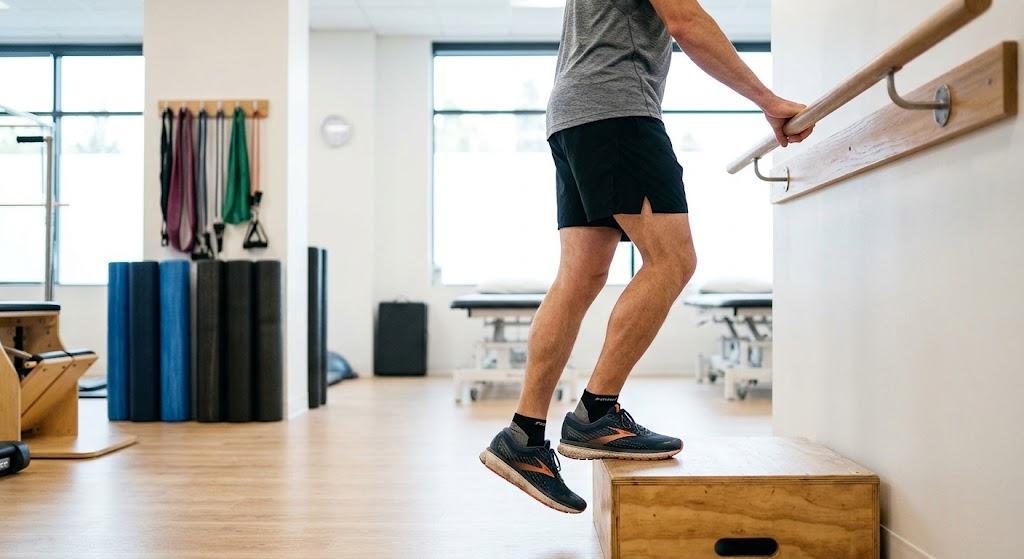
Stand on the balls of your feet at the edge of a step, holding a wall or rail for balance. Rise up on both feet, shift your weight to the affected leg, then lower that heel slowly below the step level over 3 to 4 seconds. This slow, controlled lowering phase is the part doing most of the work, so don’t rush it. Start with the knee straight to target the gastrocnemius, then progress to a bent-knee version to target the soleus. If your pain sits at the heel rather than mid-tendon, stop the lowering at step level instead of dropping below it, since the deeper position compresses the tendon against the bone.
Leg Press Heel Raises
If a step feels too aggressive early on, a leg press machine lets you dial in exactly how much body weight you’re loading through the tendon, which is useful for building back up gradually before moving to full-weight standing versions.
Progress load and reps gradually over several weeks. Some working discomfort during the exercise is normal and expected in tendon rehab. Sharp pain that lingers well after you stop is the signal to back off.
Building Back to Running
Don’t return to your normal mileage all at once. A run-walk progression, starting with short intervals and gradually increasing running time, lets you test the tendon’s tolerance without betting a full session on it. Before progressing to speed work or hills, you should be able to do single-leg heel raises on the affected side with comparable strength and minimal pain compared to the other side.
Preventing Achilles Tendinitis
- Increase mileage and intensity gradually rather than jumping volume week to week.
- Build calf strengthening into your regular training, not just after pain shows up.
- Stretch your calves and lower legs routinely, especially before and after harder efforts.
- Choose supportive, appropriate footwear for your foot type and running surface.
- Build in rest days between harder training sessions rather than stacking them back to back.
The same load-management principles apply to lifting injuries and other overuse patterns beyond running. Our guide on how to prevent common weightlifting injuries covers the training habits that keep tendons and joints healthy across the board.
When to See a Physical Therapist for Achilles Pain

Most cases of Achilles tendinopathy improve over 6 to 12 weeks with consistent eccentric loading, but a few signs mean it’s worth getting evaluated by a healthcare professional rather than pushing through alone: pain that’s getting worse rather than better after a few weeks of exercise, sudden sharp pain or a “pop” (which can signal a partial or complete tendon tear rather than tendinopathy), or significant swelling and difficulty walking normally. A physical therapist can confirm whether you’re dealing with mid-portion or insertional tendinopathy, since the exercise approach differs between the two, and physical therapy can also look further up the kinetic chain, including hip and glute strength, running mechanics, and supportive shoes, for factors putting extra strain through the largest tendon in your body. Beyond pain relief, the goal of a good rehab plan is building loading capacity so the tendon can handle your actual training volume, not just quieting symptoms temporarily. Simple ankle pumps and circles can also boost blood flow to the lower leg while the tendon is still irritable.
If Achilles pain keeps limiting your training despite doing the right exercises, Sustain Physical Therapy and Performance in Boston’s Back Bay treats runners with Achilles tendon pain and builds the return-to-running plan around your actual mileage goals instead of a generic timeline. Get started with an evaluation if you’d rather have a professional map out your specific loading progression.
Achilles tendinopathy responds well to patient, progressive strengthening, even though it can take longer to resolve than a simple strain. Staying consistent with eccentric loading, rather than alternating between total rest and pushing through pain, is what actually rebuilds the tendon’s capacity to handle running again and helps alleviate pain without risking further injury.
Frequently Asked Questions
What’s the Single Best Exercise for Achilles Tendonitis?
There isn’t one exercise that outperforms all others, but eccentric heel raises, the slow, controlled lowering phase off a step or leg press, have the strongest research backing for mid-portion Achilles tendinopathy, which is why they anchor most rehab protocols. For pain right at the heel (insertional), keep the lowering at step level.
What’s the Fastest Way to Heal Achilles Tendonitis?
There’s no real shortcut past the tendon’s own remodeling timeline, which typically runs 6 to 12 weeks with consistent loading. Consistent eccentric strengthening and sensible training volume get you there as fast as the tissue allows. Rushing back to full mileage too soon usually sets recovery back further.
What Are Two Signs of Achilles Tendonitis?
The two most common early signs are morning stiffness or pain in the tendon that eases as you warm up, and pain that appears at the start of a run and sometimes fades during it, only to return afterward. Thickening or a noticeable lump in the tendon is also common as it progresses.
Should You Stretch Your Achilles Tendon If It Hurts?
Gentle stretching is usually fine and often helpful, but back off if stretching reproduces sharp pain rather than a mild pulling sensation, especially with insertional tendinopathy, where aggressive stretching can compress and irritate the tendon at its attachment point rather than help it.